Church Background: Holy Oils

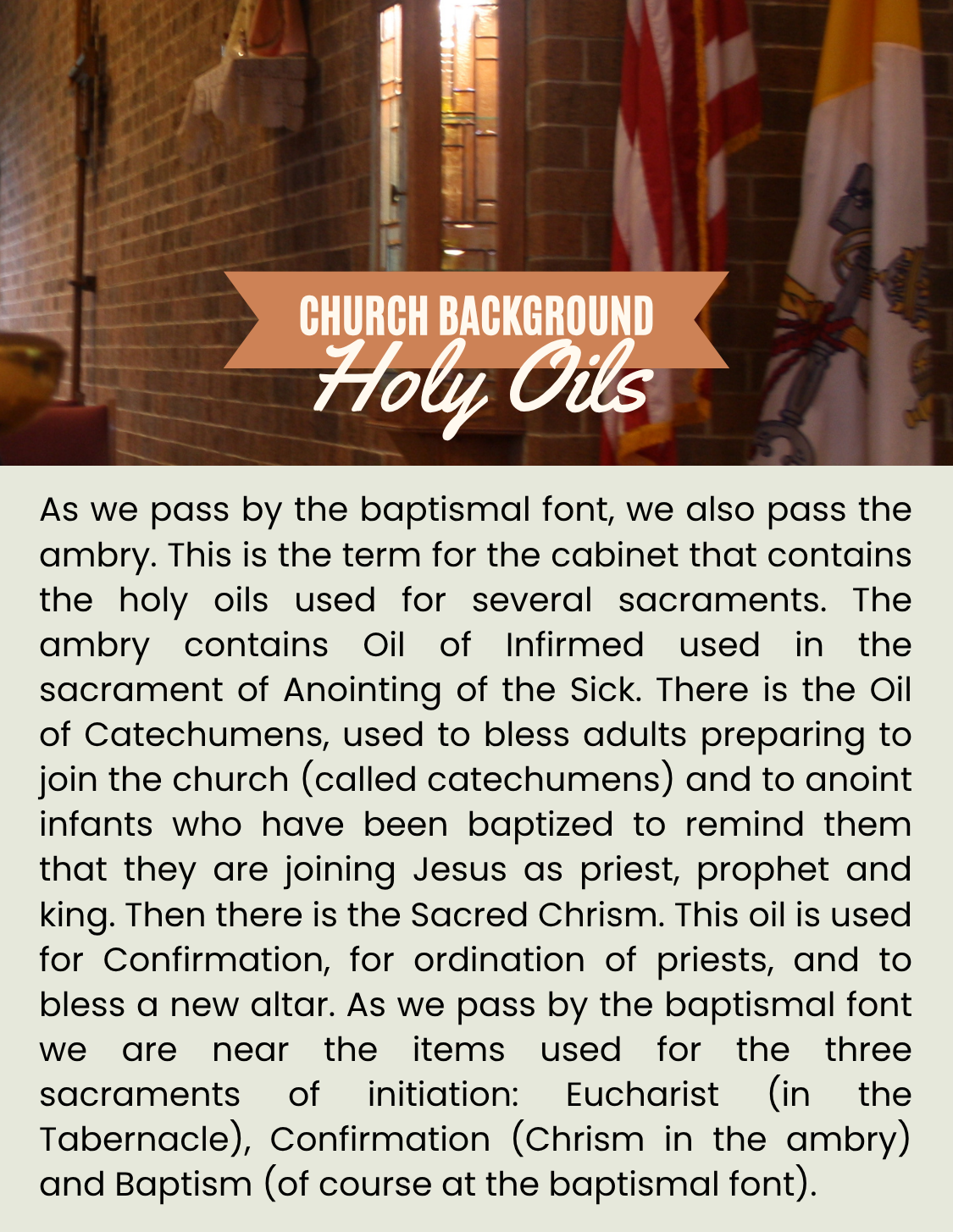
As we pass by the baptismal font, we also pass the ambry. This is the term for the cabinet that contains the holy oils used for several sacraments. The ambry contains Oil of Infirmed used in the sacrament of Anointing of the Sick. There is the Oil of Catechumens, used to bless adults preparing to join the church (called catechumens) and to anoint infants who have been baptized to remind them that they are joining Jesus as priest, prophet and king. Then there is the Sacred Chrism. This oil is used for Confirmation, for ordination of priests, and to bless a new altar. As we pass by the baptismal font we are near the items used for the three sacraments of initiation: Eucharist (in the Tabernacle), Confirmation (Chrism in the ambry) and Baptism (of course at the baptismal font).

Church Background: Baptismal Font

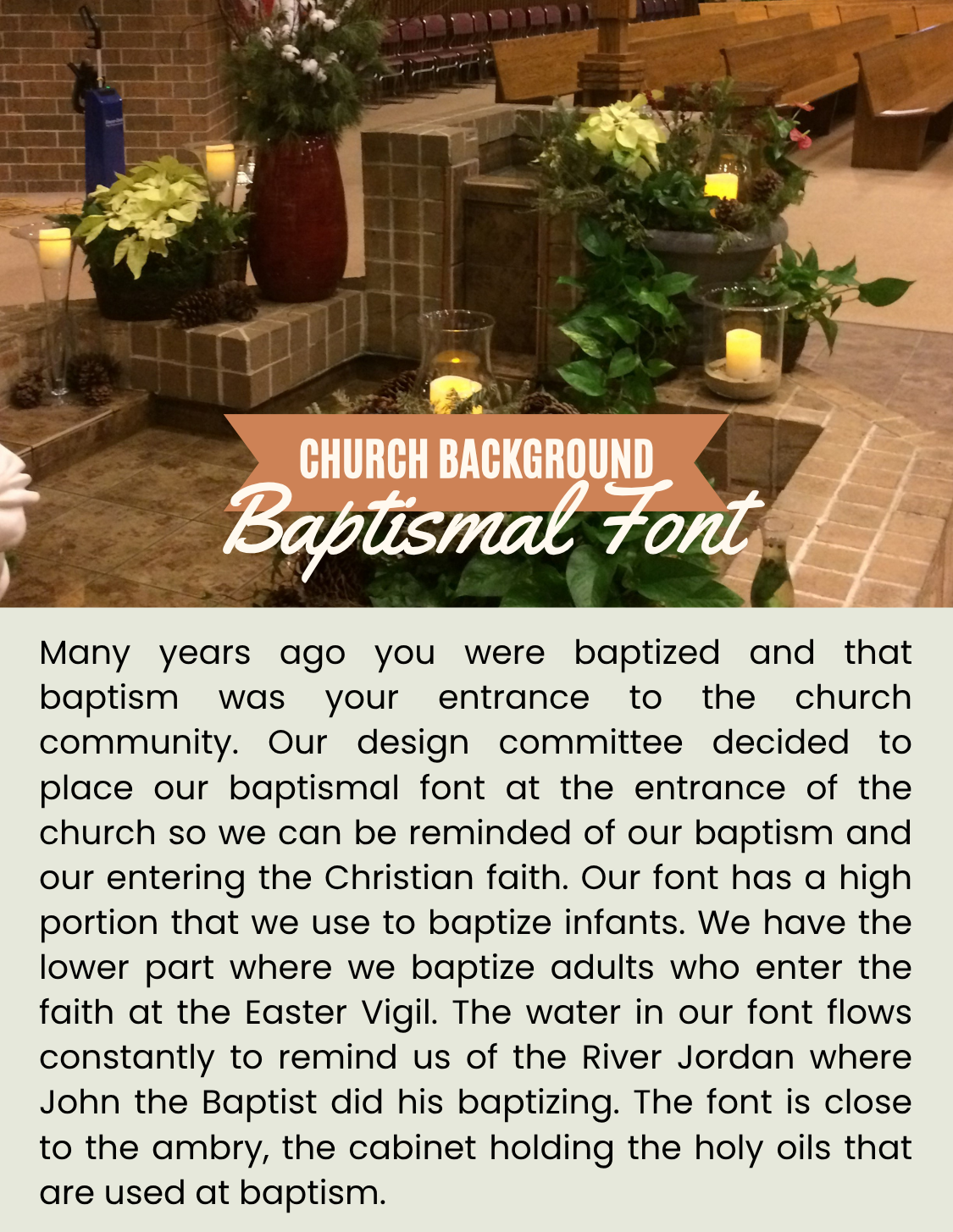
Many years ago you were baptized and that baptism was your entrance to the church community. Our design committee decided to place our baptismal font at the entrance of the church so we can be reminded of our baptism and our entering the Christian faith. Our font has a high portion that we use to baptize infants. We have the lower part where we baptize adults who enter the faith at the Easter Vigil. The water in our font flows constantly to remind us of the River Jordan where John the Baptist did his baptizing. The font is close to the ambry, the cabinet holding the holy oils that are used at baptism.

Church Background: Managing our Sound

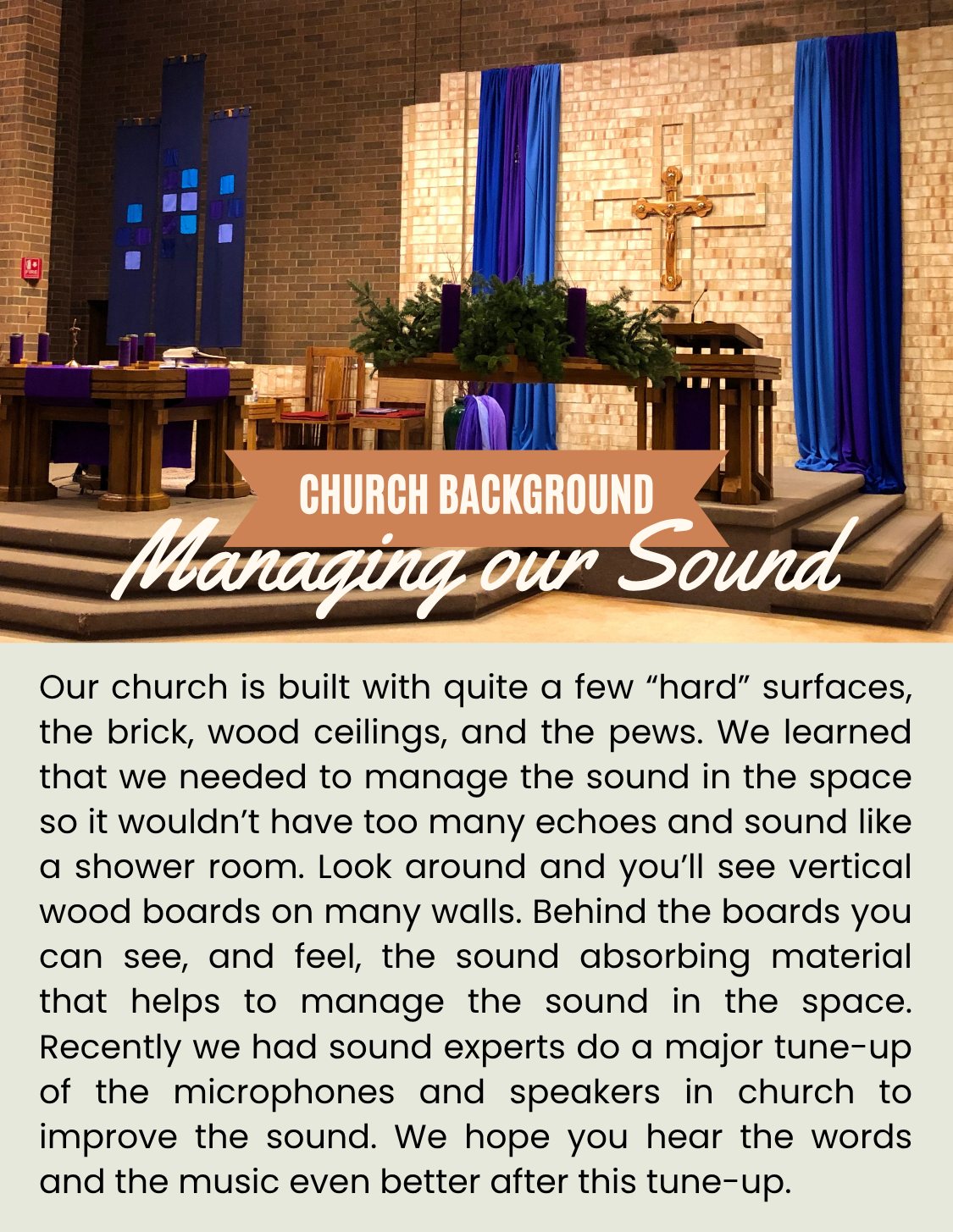
Our church is built with quite a few “hard” surfaces, the brick, wood ceilings, and the pews. We learned that we needed to manage the sound in the space so it wouldn’t have too many echoes and sound like a shower room. Look around and you’ll see vertical wood boards on many walls. Behind the boards you can see, and feel, the sound absorbing material that helps to manage the sound in the space. Recently we had sound experts do a major tune-up of the microphones and speakers in church to improve the sound. We hope you hear the words and the music even better after this tune-up.

Church Background: Day Chapel & Tabernacle

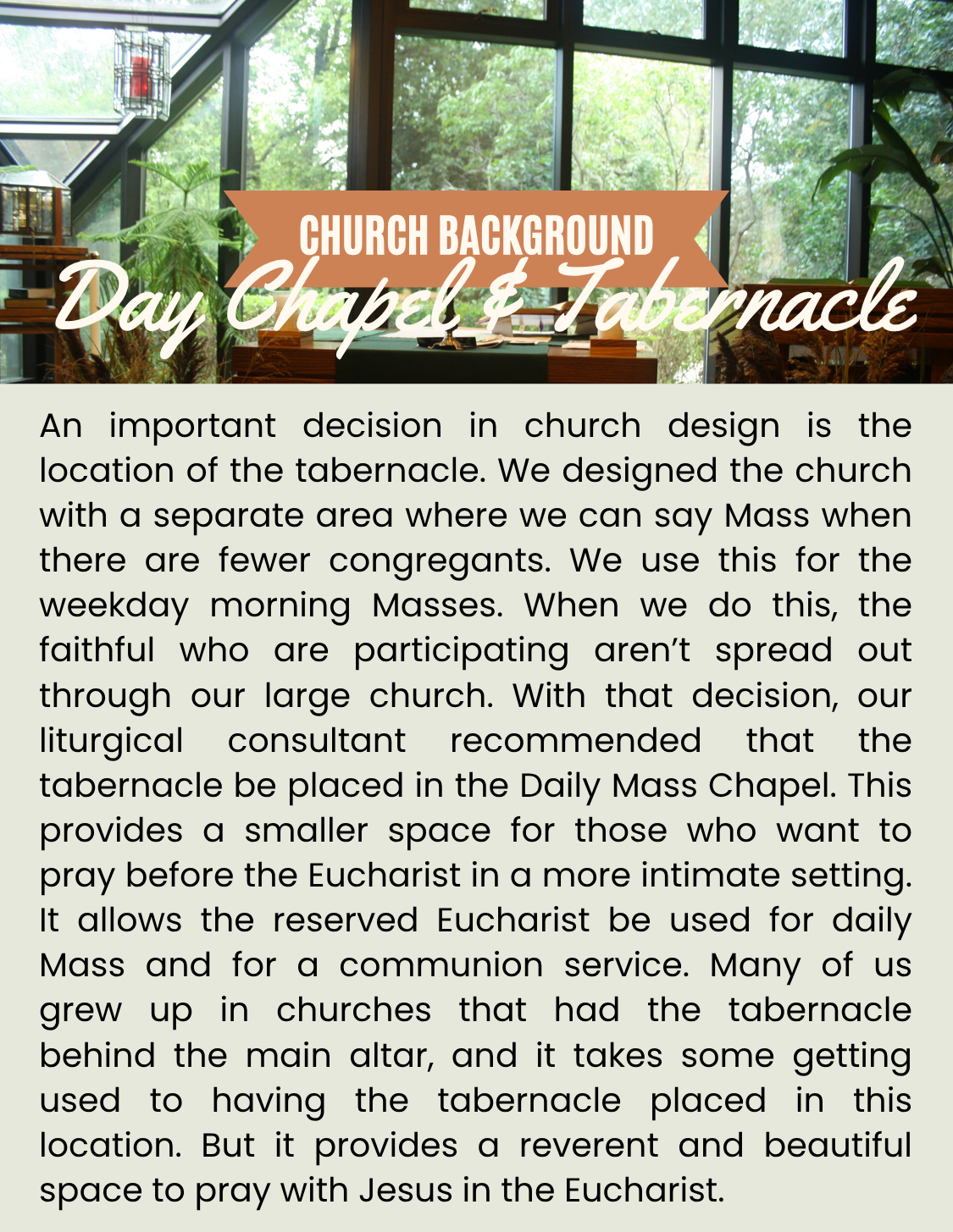
An important decision in church design is the location of the tabernacle. We designed the church with a separate area where we can say Mass when there are fewer congregants. We use this for the weekday morning Masses. When we do this, the faithful who are participating aren’t spread out through our large church. With that decision, our liturgical consultant recommended that the tabernacle be placed in the Daily Mass Chapel. This provides a smaller space for those who want to pray before the Eucharist in a more intimate setting. It allows the reserved Eucharist be used for daily Mass and for a communion service. Many of us grew up in churches that had the tabernacle behind the main altar, and it takes some getting used to having the tabernacle placed in this location. But it provides a reverent and beautiful space to pray with Jesus in the Eucharist.

Church Background: Pews & Chairs

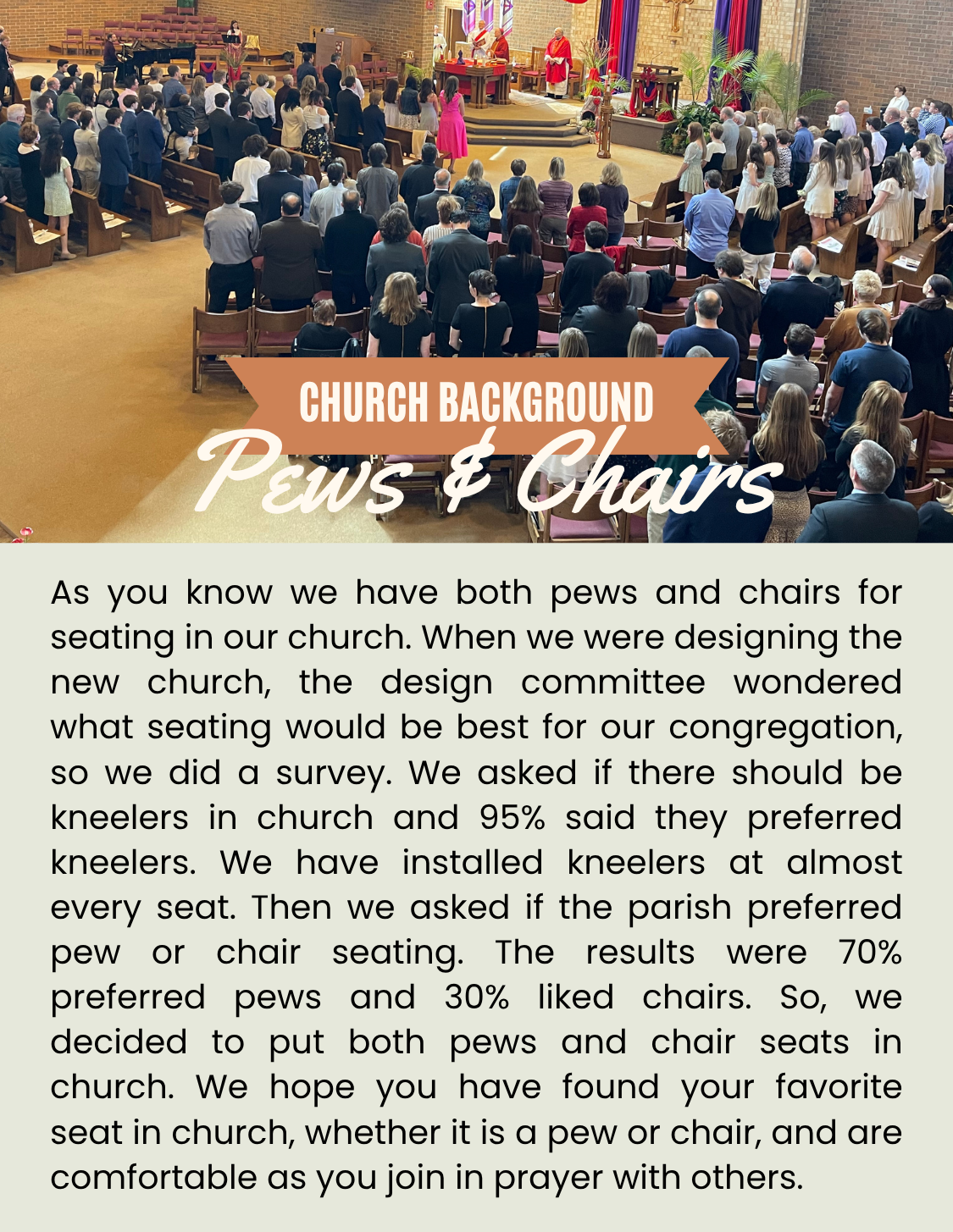
As you know we have both pews and chairs for seating in our church. When we were designing the new church, the design committee wondered what seating would be best for our congregation, so we did a survey. We asked if there should be kneelers in church and 95% said they preferred kneelers. We have installed kneelers at almost every seat. Then we asked if the parish preferred pew or chair seating. The results were 70% preferred pews and 30% liked chairs. So, we decided to put both pews and chair seats in church. We hope you have found your favorite seat in church, whether it is a pew or chair, and are comfortable as you join in prayer with others.

Church Background: Entry Doors

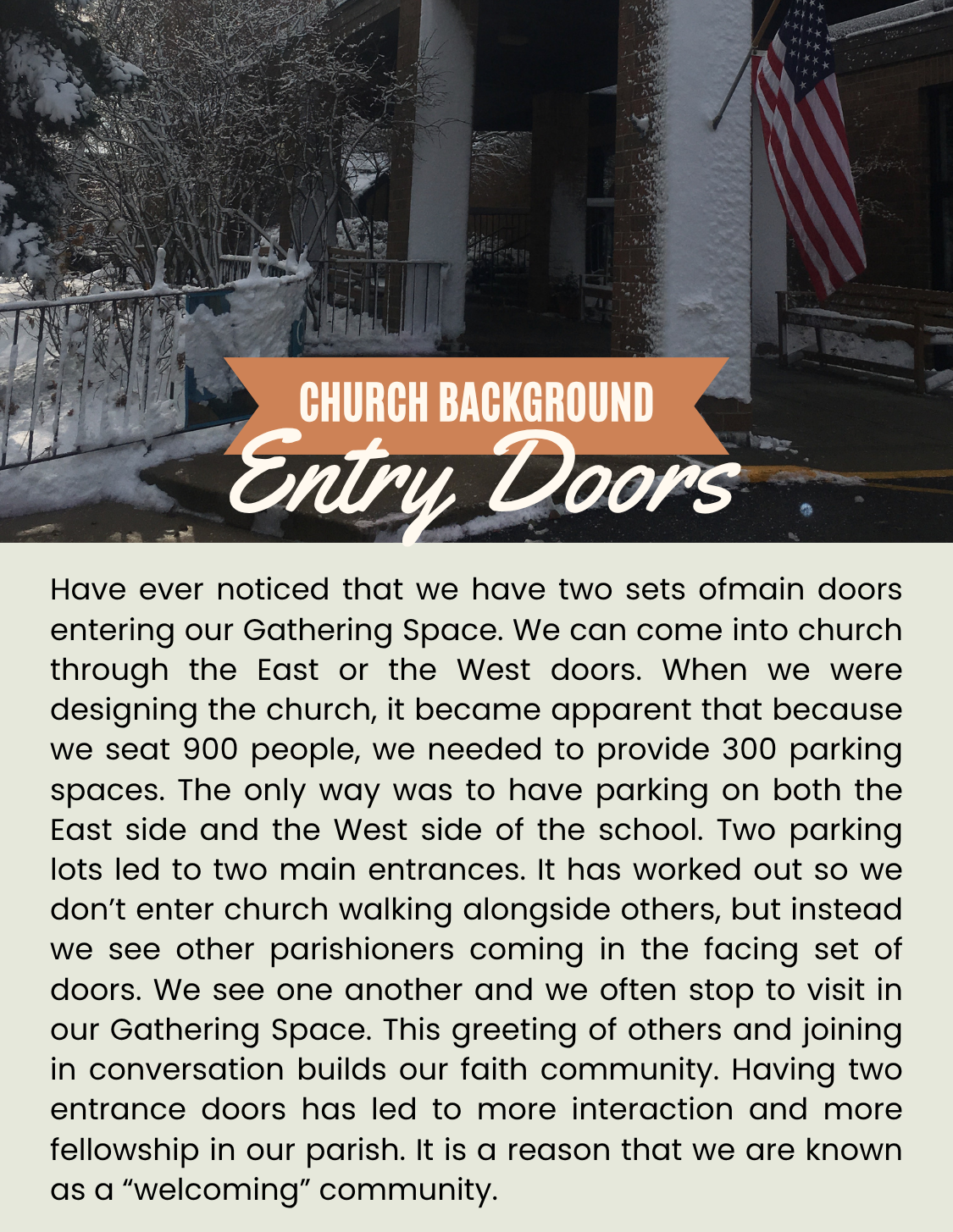
Have ever noticed that we have two sets of main doors entering our Gathering Space. We can come into church through the East or the West doors. When we were designing the church, it became apparent that because we seat 900 people, we needed to provide 300 parking spaces. The only way was to have parking on both the East side and the West side of the school. Two parking lots led to two main entrances. It has worked out so we don’t enter church walking alongside others, but instead we see other parishioners coming in the facing set of doors. We see one another and we often stop to visit in our Gathering Space. This greeting of others and joining in conversation builds our faith community. Having two entrance doors has led to more interaction and more fellowship in our parish. It is a reason that we are known as a “welcoming” community.

Church Background: Picking Materials

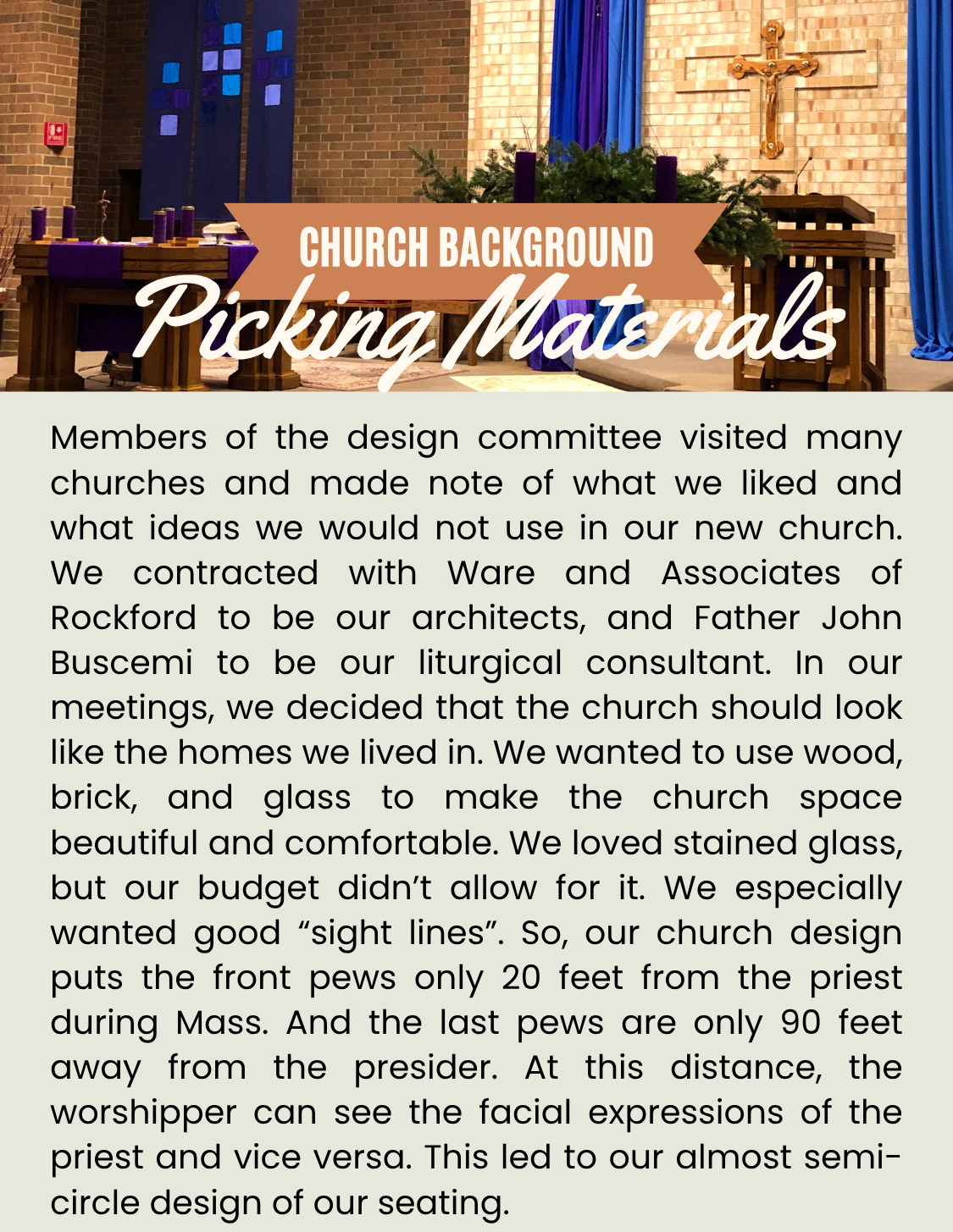
Members of the design committee visited many churches and made note of what we liked and what ideas we would not use in our new church. We contracted with Ware and Associates of Rockford to be our architects, and Father John Buscemi to be our liturgical consultant. In our meetings, we decided that the church should look like the homes we lived in. We wanted to use wood, brick, and glass to make the church space beautiful and comfortable. We loved stained glass, but our budget didn’t allow for it. We especially wanted good “sight lines”. So, our church design puts the front pews only 20 feet from the priest during Mass. And the last pews are only 90 feet away from the presider. At this distance, the worshipper can see the facial expressions of the priest and vice versa. This led to our almost semi-circle design of our seating.

Church Background Series: The Design Committee

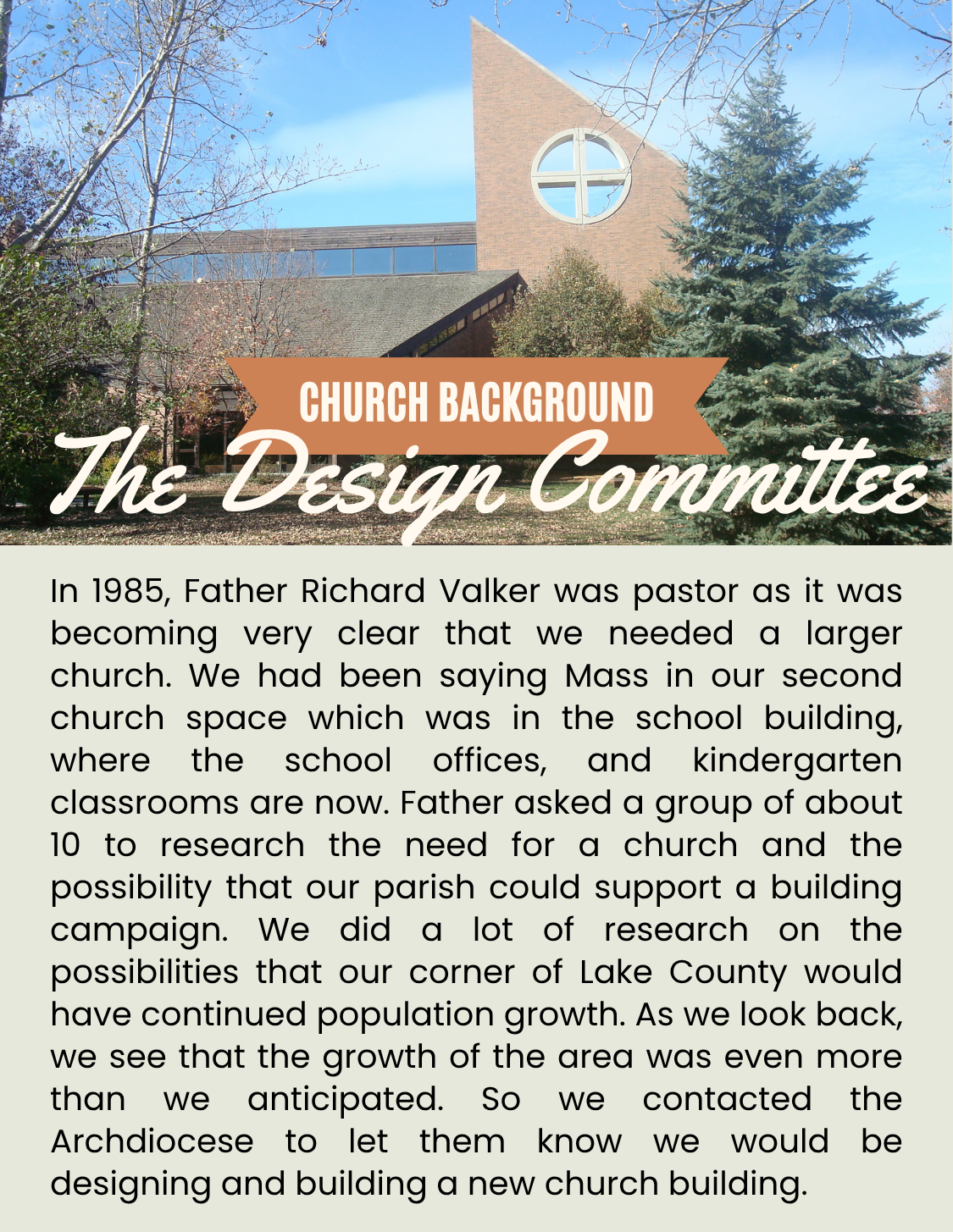
In 1985, Father Richard Valker was pastor as it was becoming very clear that we needed a larger church. We had been saying Mass in our second church space which was in the school building, where the school offices, and kindergarten classrooms are now. Father asked a group of about 10 to research the need for a church and the possibility that our parish could support a building campaign. We did a lot of research on the possibilities that our corner of Lake County would have continued population growth. As we look back, we see that the growth of the area was even more than we anticipated. So we contacted the Archdiocese to let them know we would be designing and building a new church building.

Church Background Series: Our Altar

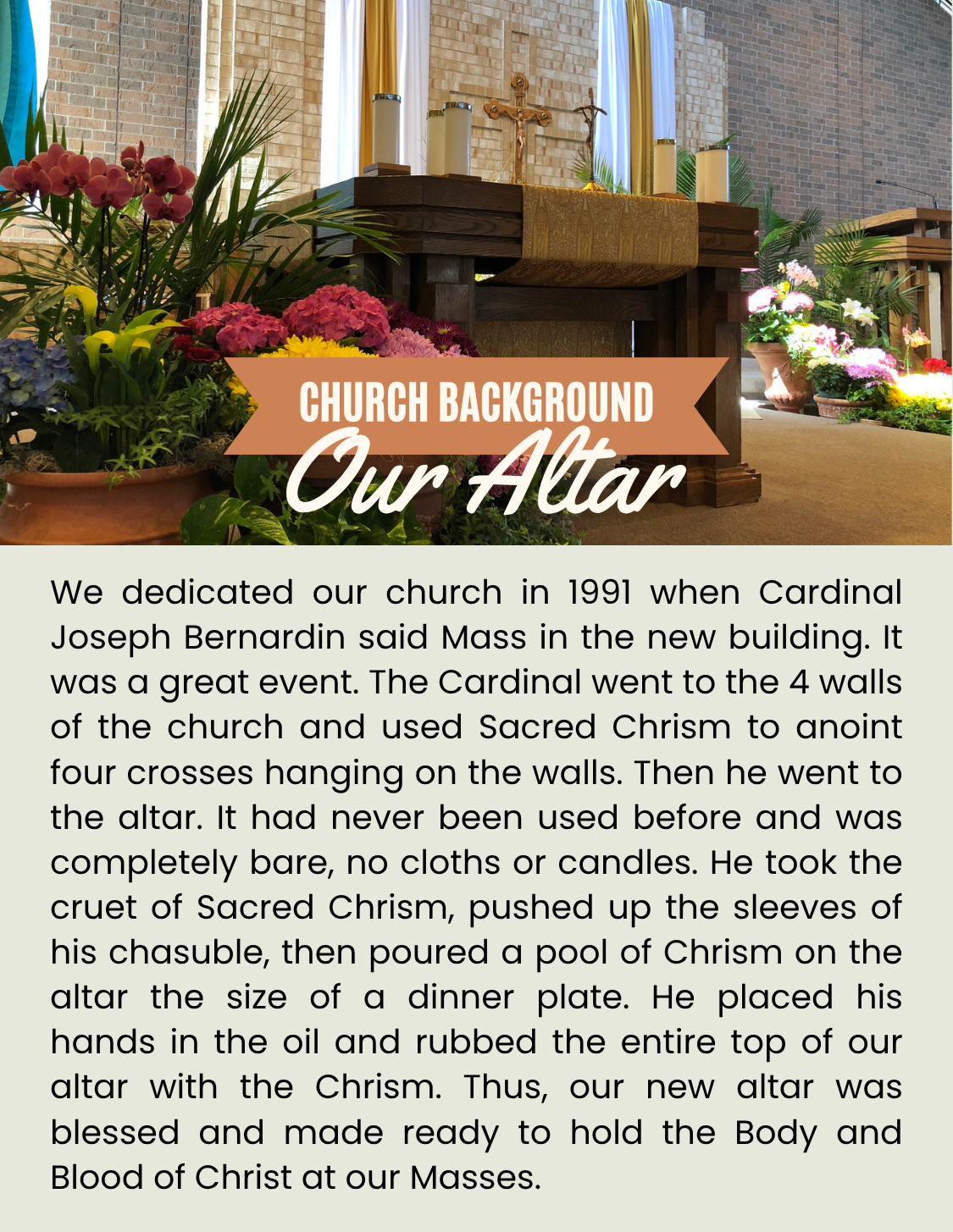
We dedicated our church in 1991 when Cardinal Joseph Bernardin said Mass in the new building. It was a great event. The Cardinal went to the 4 walls of the church and used Sacred Chrism to anoint four crosses hanging on the walls. Then he went to the altar. It had never been used before and was completely bare, no cloths or candles. He took the cruet of Sacred Chrism, pushed up the sleeves of his chasuble, then poured a pool of Chrism on the altar the size of a dinner plate. He placed his hands in the oil and rubbed the entire top of our altar with the Chrism. Thus, our new altar was blessed and made ready to hold the Body and Blood of Christ at our Masses.